What is a Donor-Advised Fund?
A donor-advised fund lets itemizers deduct a gift in the year they contribute while grants go out later. Donated stock also avoids capital gains tax.
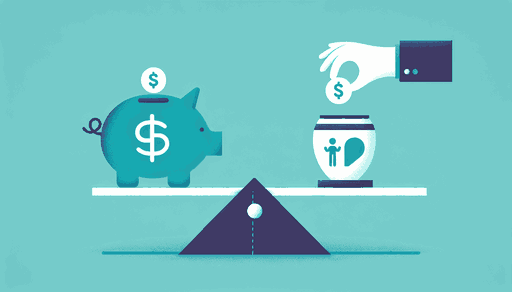
A donor-advised fund (DAF) is a charitable giving account held at a public charity. You contribute cash, stock, or other assets, take a tax deduction in the year you contribute if you itemize, and then recommend grants from the account to the charities you choose, on your own timeline.
The charity that holds the account is called the sponsoring organization. Sponsors include national charities affiliated with investment firms, such as Fidelity Charitable, Vanguard Charitable, and DAFgiving360 (formerly Schwab Charitable), along with community foundations and single-cause charities. Once you contribute, the gift is irrevocable and the sponsor has legal control of the money; you keep advisory privileges over how it’s invested and where the grants go.
How Does a Donor-Advised Fund Work?
- You open an account with a sponsor, name it, and choose any successor advisors.
- You contribute. Cash and publicly traded securities are the standard options; some sponsors also take real estate, private business interests, or crypto. The contribution is a completed charitable gift, so the deduction belongs to that tax year.
- The money is invested in the sponsor’s investment options and grows tax-free. Any growth adds to what you can eventually give, but you can’t take it back.
- You recommend grants to IRS-qualified public charities. The sponsor reviews each request and, in practice, approves grants to eligible charities, though it isn’t legally required to.
The separation between steps 2 and 4 is the main point. The tax decision happens in one year; the charitable decisions can be spread over many.
Donor-Advised Fund Tax Deduction
Because a DAF sponsor is a public charity, contributions get public-charity deduction limits, which are higher than those for gifts to a private foundation.
| What you contribute | Deduction amount | Annual limit | Excess over the limit |
|---|---|---|---|
| Cash | Amount given | 60% of adjusted gross income (AGI) | Carries forward up to 5 years |
| Stock or other assets held more than one year | Fair market value | 30% of AGI | Carries forward up to 5 years |
| Assets held one year or less | Generally the lesser of your cost basis or fair market value | 50% of AGI | Carries forward up to 5 years |
The limits interact if you give more than one type of asset in the same year, and each carryforward keeps the limit it started with.
The long-term row is where DAFs earn their reputation. Give stock worth $50,000 that you bought more than a year ago for $10,000, and you can deduct the full $50,000 fair market value (subject to the 30% limit and the 0.5% floor below) while never paying tax on the $40,000 gain. Sell the stock first and donate the proceeds, and you’d owe capital gains tax on that $40,000. When the sponsor sells the shares, the sale happens inside a tax-exempt charity, so no one owes tax on the gain.
2026 Charitable Deduction Changes
The 2025 tax law (P.L. 119-21, often called the One Big Beautiful Bill Act) changed charitable deductions starting in 2026, in three ways that matter for DAF donors.
- A 0.5% of AGI floor for itemizers. Only the part of your total charitable giving above 0.5% of your AGI is deductible. With a $200,000 AGI, the first $1,000 of giving each year produces no deduction.
- A 35% cap for the top bracket. If you’re in the 37% bracket, itemized deductions are reduced so each deducted dollar saves at most about 35 cents.
- A new deduction for non-itemizers that excludes DAFs. If you take the standard deduction, you can now deduct up to $1,000 ($2,000 married filing jointly) of cash gifts to charity, but contributions to a donor-advised fund don’t count.
The 60% cash limit, which had been scheduled to revert to 50%, was made permanent.
Bunching Donations with a DAF
The floor and the standard deduction ($32,200 for married couples filing jointly in 2026) both reward giving in larger, less frequent chunks. A DAF makes that easy: you contribute several years of giving at once, itemize that year, then take the standard deduction while the grants go out on the usual schedule.
Take a married couple with $200,000 of AGI, $15,000 of other itemized deductions such as state taxes and mortgage interest, and a habit of giving $10,000 a year:
| Give $10,000 directly each year | Contribute $30,000 to a DAF in year 1 | |
|---|---|---|
| Year 1 deductions | $34,200 (standard + $2,000 non-itemizer deduction) | $44,000 itemized ($15,000 + $30,000 - $1,000 floor) |
| Year 2 deductions | $34,200 | $32,200 standard |
| Year 3 deductions | $34,200 | $32,200 standard |
| Three-year total | $102,600 | $108,400 |
The charities receive the same $30,000 either way. Bunching produces $5,800 more in deductions over the three years.
A DAF gift can be modeled in ProjectionLab as a charity expense funded from a taxable account, with the deduction in that year’s taxes and any carryforward applied in later years.
Donor-Advised Fund Rules
Grants can’t benefit you. Using DAF money for anything that gives you or your family more than an incidental benefit, such as event tickets or tuition, can trigger excise taxes. Grants to individuals aren’t allowed at all.
QCDs can’t go into a DAF. A qualified charitable distribution (QCD) from an IRA must go directly to an eligible charity, and donor-advised funds are specifically excluded.
There’s no federal minimum payout. Unlike a private foundation, a DAF isn’t required to distribute a set percentage each year. Some sponsors have their own inactivity policies that apply if an account makes no grants for several years.
Fees and minimums vary. Sponsors charge an administrative fee, usually a percentage of assets, plus the expense ratios of the underlying investments. Minimum opening contributions vary widely by sponsor, and some have none.
Donor-Advised Fund vs. Private Foundation
| Donor-advised fund | Private foundation | |
|---|---|---|
| Deduction limit, cash | 60% of AGI | 30% of AGI |
| Deduction limit, appreciated public stock | 30% of AGI | 20% of AGI |
| Required annual payout | None | 5% of assets |
| Tax on investment income | None | Excise tax on net investment income |
| Control | Advisory; sponsor has legal control | Full control by the foundation’s board |
| Setup and filing | Online account, no separate tax return | Legal entity, annual Form 990-PF |
| Privacy | Grants can be made anonymously | Grants and assets are public on Form 990-PF |
A foundation makes sense when you want to hire staff, make grants to individuals (scholarships and similar awards need grant procedures approved in advance by the IRS), or keep direct control across generations. For giving that goes to established charities, a DAF does the same job with less cost and paperwork.
Frequently Asked Questions
What is a donor-advised fund in simple terms? A charitable account you fund now and give from later. You get the tax deduction when the money goes in, and you choose which charities receive grants over the following months or years.
Can I deduct a DAF contribution if I don’t itemize? No. The deduction for non-itemizers that starts in 2026 covers cash gifts made directly to qualifying charities, and it specifically excludes contributions to donor-advised funds.
Do donor-advised funds have minimum distribution requirements? Not under federal law. You can leave money in the fund indefinitely, though individual sponsors may require some grant activity or reassign dormant accounts under their own policies.
Can I use a QCD to fund a donor-advised fund? No. Qualified charitable distributions from an IRA can’t be made to a DAF. If you’re 70 1/2 or older and want the QCD’s tax treatment, send it directly to the charity.
How do I set up a donor-advised fund? Choose a sponsor based on its fees, investment options, and minimums, open an account online, and make your first contribution. Transferring appreciated shares from a brokerage account usually takes a few days, so start well before December 31 if you want the deduction this year.
Can I get my money back from a donor-advised fund? No. The contribution is an irrevocable gift to the sponsoring charity, which is what makes it deductible. You can only recommend how it’s granted.

Disclaimer: The content, tools, and resources on ProjectionLab.com are intended solely for informational and educational purposes and should not be construed as professional financial or investment advice. Our materials are designed to provide general guidance and are based on the input and data provided by users. ProjectionLab makes no guarantee of the accuracy, completeness, or applicability of this content to individual circumstances. Effective financial planning and investment involve comprehensive consideration of a wide array of personal financial factors. The tools and resources available on ProjectionLab are aimed at helping users develop an understanding of their financial trajectory. However, they should not be solely relied upon for creating a complete financial plan. We strongly recommend consulting a financial services professional who can provide personalized advice based on your unique financial situation before making any significant financial decisions. While we endeavor to keep the information on ProjectionLab current and accurate, the content may differ from that found on other financial institutions, service providers, or specific product sites. All content and tools on ProjectionLab are provided without any guarantees or warranties of any kind.